Space, one minute at a time.
Carl is the host of our animated space series. Each episode answers one big question, matches a mission in the app, and ends with something to try at home with a grown-up.

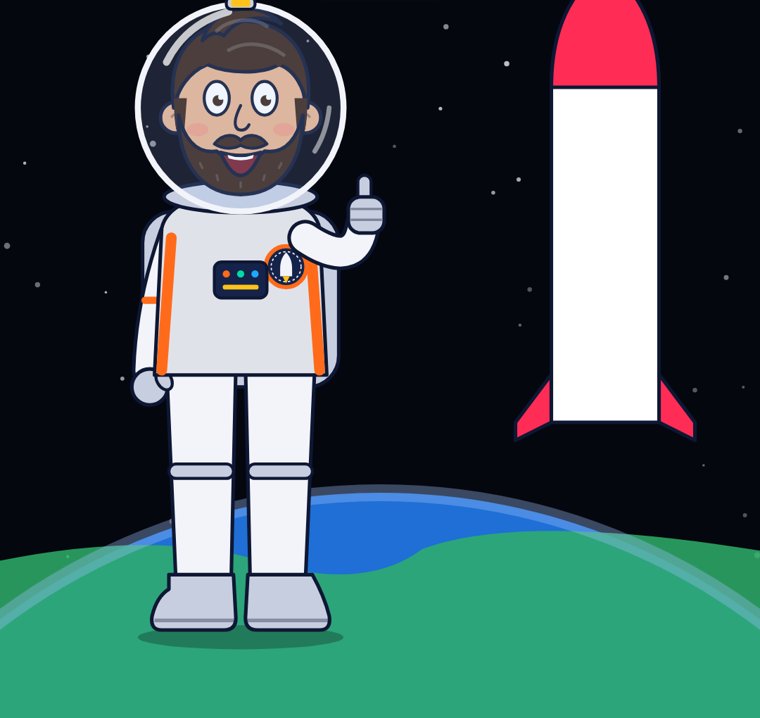
What is a rocket?
How does a rocket fly? Captain Carl shows it with a balloon you already have at home.
Thread a string through a straw, then tie the string between two chairs. Tape a blown-up balloon to the straw and let go. Count how many steps it flies, then try to beat it. A grown-up blows up the balloon. Balloons are a choking risk for kids under 8, so pick up broken pieces right away.
Read what Carl says
- Hey, cadets! Captain Carl Cosmos here. Buckle up!
- Today's big question: how does a rocket fly?
- Here's the secret. A rocket shoots hot gas down... super fast.
- And when the gas goes down... the rocket gets pushed up!
- You can see it with a balloon. Blow it up... and let it go.
- Whoosh! Ha! The air rushes out one way, and the balloon zooms the other way.
- But wait. Fire needs air to burn... and space has no air!
- So rockets bring their own! Giant tanks of super cold oxygen ride along with the fuel.
- Big rockets are built in pieces called stages. When a stage runs out of fuel, it drops off, so the rocket gets lighter.
- And some first stages fly all the way back and land! That's out of this world!
- Build a balloon rocket at home with a grown-up. Three, two, one... mission accomplished!
Captions are in the video. Carl's voice is made with an AI voice tool.
New episodes follow the missions in the app.
The next episodes are about why rockets tilt, fuel and oxygen, liquid and solid rockets, and the launch pad. Each one goes up here once it is ready.
Every episode is checked against NASA, ESA and JPL sources before it goes out. Follow along on Instagram.
Get the watch sheet and new episodes.
You get the free Launch Night watch sheet right away, and news when new episodes and the app are ready. You can unsubscribe with one click.